
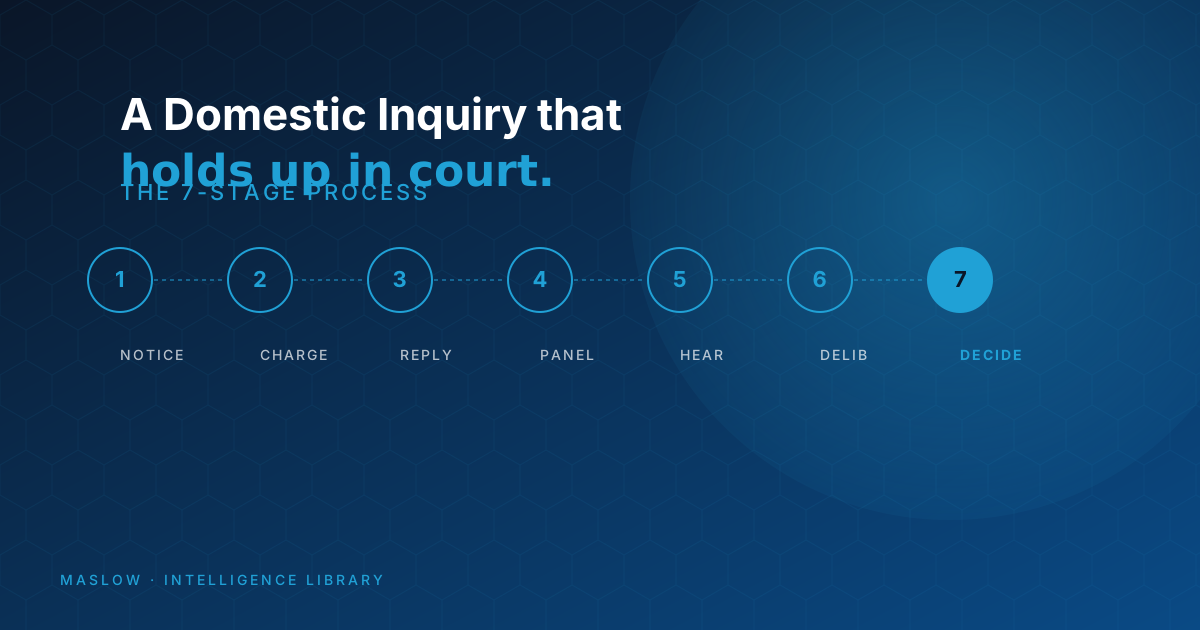
A domestic inquiry (DI) in Malaysia is a formal internal hearing that employers must conduct before dismissing an employee for misconduct. The process must satisfy the principles of natural justice: the employee receives written charges specifying the misconduct, adequate time to prepare a defence, the right to be heard before an impartial panel, and a documented decision. A DI that fails on any of these procedural requirements is worse than conducting no DI at all - it creates a record of the employer's attempt and its inadequacy.
Why the DI Exists
The Employment Act 1955 requires employers to conduct a due inquiry before terminating an employee for misconduct. The Industrial Court has consistently held that "due inquiry" means a process that satisfies natural justice - not a cursory meeting, not a conversation in the manager's office, and not a panel review of documents without hearing from the employee.
The purpose is not to determine guilt. The purpose is to give the employee a fair opportunity to answer the allegations before a decision is made. Employers who approach a DI as a formality to justify a predetermined outcome create the exact procedural vulnerability the court looks for.
The 7-Stage DI Process
Domestic Inquiry Process
Stage 1 - Preliminary investigation
Before initiating a DI, the employer must establish that there is a prima facie case of misconduct. This means gathering sufficient evidence to formulate specific charges. The investigation should identify what happened, when, where, who was involved, and what evidence exists.
This stage is internal and does not involve the employee being charged. However, the employer may suspend the employee on half pay during investigation under Section 14(2) of the Employment Act 1955 - provided the investigation is completed and the inquiry held within two weeks of suspension. If no inquiry is held within two weeks, the employer must restore full wages for the suspension period.
Stage 2 - Framing the charges
The charges must be specific, not vague. Each charge should state the nature of the misconduct, the date and time it occurred, the location, and how it constitutes a breach of the employee's obligations.
A charge that reads "misconduct on multiple occasions" is insufficient. A charge that reads "on 14 January 2026, at approximately 10:30 AM, at the Kota Kemuning warehouse, you were found to have removed company inventory (6 units of Product X) without authorization, in breach of Section 4.2 of the Employee Handbook" - that is a charge that survives scrutiny.
Stage 3 - Issuing the charge sheet and notice of inquiry
The employee receives a formal charge sheet listing all charges, along with a notice of the DI hearing that specifies the date, time, and location. The employee must be given reasonable time to prepare their defence - a minimum of 7 days is generally considered reasonable, though complex cases may warrant more.
The charge sheet should inform the employee of their right to be accompanied by a fellow employee (not an external lawyer, unless the employer's representative is also legally qualified). The employee should also be informed of the names of the panel members so they can raise any objections regarding impartiality.
Stage 4 - Constituting the panel
The DI panel should consist of individuals who have no prior involvement in the matter. A panel of two to three members is standard. The chairperson should have sufficient seniority and understanding of the process.
Critical disqualifications: the employee's direct supervisor who reported the misconduct should not sit on the panel. The person who conducted the preliminary investigation should not sit on the panel. Anyone who has expressed a view on the employee's guilt prior to the hearing should not sit on the panel.
Stage 5 - Conducting the hearing
The hearing follows a structured sequence. The employer's representative presents the case - reading the charges, calling witnesses, and presenting documentary evidence. The employee or their representative has the right to cross-examine each witness.
After the employer's case, the employee presents their defence. They may call their own witnesses and present evidence. The employer's representative may cross-examine the employee's witnesses.
The panel must keep minutes of the proceedings. Every question, answer, and objection should be recorded. These minutes become the primary evidence if the case proceeds to the Industrial Court.
Stage 6 - Panel deliberation and findings
After both sides have been heard, the panel deliberates and arrives at findings on each charge. The standard of proof is the balance of probabilities - not beyond reasonable doubt. The panel determines whether, on the evidence presented, it is more likely than not that the misconduct occurred.
The panel's findings should be documented in writing, with reasons for each finding. A finding of "guilty" without explanation is insufficient. The panel should state what evidence they relied on and why they found the employee's defence unpersuasive (or persuasive, if acquitted).
Stage 7 - Decision and communication
Based on the panel's findings, the employer makes a decision. This is where the three-option outcome framework applies:
Option 1 - Final warning and close. If the misconduct is proven but does not warrant dismissal given the circumstances (first offense, long service, mitigating factors), issue a final written warning. The DI record remains on file. If the employee commits further misconduct, the documented DI strengthens any future action.
Option 2 - Negotiate a separation. Where both parties recognise that the employment relationship has broken down, a negotiated resignation or mutual separation agreement may be the most pragmatic outcome. The employee's record is preserved, the employer avoids court exposure, and both parties move forward. This is often the right outcome when the misconduct is proven but the circumstances are complex - for example, a long-serving employee whose performance deteriorated due to personal circumstances.
Option 3 - Proceed to dismiss. If the misconduct is serious, the evidence is clear, and the DI process was procedurally sound, the employer proceeds with termination. The dismissal letter should reference the DI, the charges, the findings, and the basis for the decision. This creates a complete documentary trail that the Industrial Court can examine.
The decision must be communicated to the employee in writing, with a copy of the DI panel's findings.
The Mistakes That Invalidate a DI
Vague charges
"Poor attitude" is not a charge. "Insubordination" without specifying the incident is not a charge. Every charge must be specific enough for the employee to understand exactly what they are accused of and prepare a targeted defence.
Panel bias
A panel member who was involved in the events leading to the charges, who has expressed an opinion about the employee's guilt, or who has a personal conflict with the employee taints the entire proceeding. Even if the findings are correct, a biased panel renders the DI procedurally unfair.
Denial of representation
The employee has the right to be accompanied and assisted by a fellow employee. Denying this right - or scheduling the hearing at a time or location that makes it impractical - is a procedural failure.
Inadequate notice
Issuing a charge sheet on Monday for a hearing on Wednesday does not provide reasonable time to prepare. The more complex the charges, the more time is needed.
Predetermined outcome
If the decision to dismiss was made before the DI was conducted, the DI is a sham. The court detects this through various signals: the dismissal letter was drafted before the hearing, the panel spent minimal time deliberating, no witnesses were called for the employer's case, or the employee's defence was not meaningfully considered.
No minutes or incomplete minutes
If the hearing is not documented, the employer cannot demonstrate what occurred during the proceeding. The court will draw adverse inferences from missing records.
When You Do Not Need a DI
A DI is required for misconduct dismissals. It is not required in the following situations:
Retrenchment or redundancy - governed by different procedures (LIFO, JTKSM notification, statutory benefits).
Termination during probation - though the employer must still demonstrate that the termination was related to the employee's unsuitability for the role and that the probationary employee was given adequate opportunity and feedback.
Mutual separation - where both parties agree to end the employment relationship by consent.
Frustration of contract - where circumstances beyond either party's control make continued employment impossible (e.g., imprisonment, loss of work permit).
Even in situations where a DI is not legally required, documenting the rationale and process for termination protects the employer against subsequent claims.
Frequently Asked Questions
How long does a typical DI take from charge sheet to decision?
Most straightforward DIs are completed within 2 to 4 weeks. Complex cases involving multiple charges, multiple witnesses, or where the employee requests adjournments can extend to 6 to 8 weeks.
Can an employee bring a lawyer to the DI?
There is no absolute right to external legal representation at a domestic inquiry. Whether to allow a lawyer to appear is the employer's discretion, and refusing one is not by itself a denial of natural justice. The employee may be accompanied by a fellow employee. The one situation that changes this: if the employer's own case is presented by a legally qualified person, the employee should be permitted equivalent representation - an inquiry where only one side has counsel is hard to defend as fair.
What happens if the employee refuses to attend the DI?
The employer should ensure the notice was properly served and the employee had reasonable time to attend. If the employee fails to attend without valid reason after being properly notified, the DI may proceed ex-parte (in the employee's absence). This should be documented carefully.
Can the same misconduct be both a DI matter and a police report?
Yes. Criminal proceedings and employment proceedings are separate tracks. An employer can conduct a DI for misconduct (e.g., theft, fraud) while simultaneously filing a police report. The DI does not need to wait for criminal proceedings to conclude.
Is the DI panel's finding binding on the Industrial Court?
No. The Industrial Court conducts its own assessment of the evidence and may reach a different conclusion. However, a well-conducted DI with thorough documentation significantly strengthens the employer's position.
Want to go deeper on this topic?
Every organisation's situation is different. Talk to Maslow Intelligence about how this applies to your specific circumstances.