
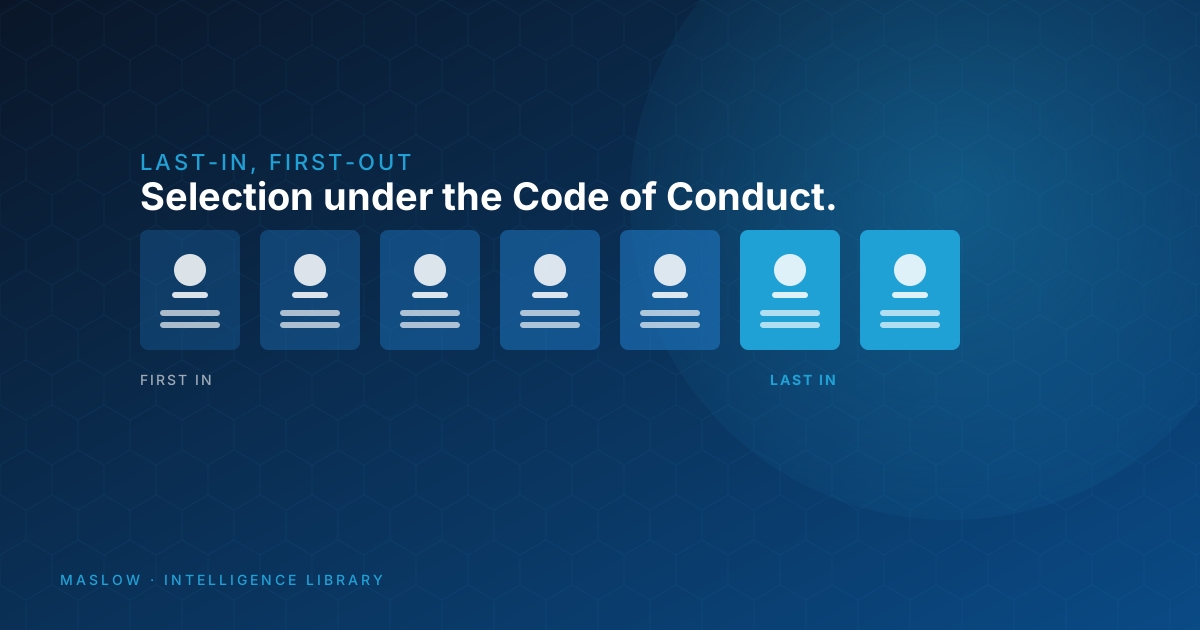
LIFO - Last In, First Out - is the default employee selection principle for retrenchment exercises in Malaysia, established by the Code of Conduct for Industrial Harmony 1975 and reinforced by decades of Industrial Court jurisprudence. Employers must terminate the most recently hired employees first within the same job category. Deviating from LIFO without documented, objective justification creates significant legal exposure - the burden of proof falls on the employer to demonstrate why LIFO was not followed.
The Legal Foundation
Retrenchment in Malaysia is governed by several overlapping frameworks. The Employment Act 1955 establishes the entitlement to termination benefits for qualifying employees. The Code of Conduct for Industrial Harmony 1975, together with settled Industrial Court practice, establishes the LIFO selection principle. The Employment (Termination and Lay-Off Benefits) Regulations 1980 are a separate instrument: they set the formula for calculating statutory termination benefits, not the order in which employees are selected. The Industrial Relations Act 1967, through Section 20, provides the avenue for employees who believe their retrenchment was unfair to challenge it.
There is no legal requirement to obtain government approval before conducting a retrenchment. However, the employer must notify the nearest Labour Department office (Jabatan Tenaga Kerja Semenanjung Malaysia - JTKSM) at least 30 days before the first termination date using the prescribed PK form. Failure to comply with this notification requirement does not invalidate the retrenchment itself, but it is a factor the Industrial Court considers when evaluating whether the exercise was conducted in good faith.
The LIFO Principle in Practice
LIFO applies within the same category of work, not across the entire organisation. An employer restructuring the production department applies LIFO among production employees - not by comparing production workers against finance or HR staff.
The principle requires that foreign workers in the same category be terminated before local employees, regardless of their hire date. This is a policy directive reinforced by the Ministry of Human Resources and consistently upheld by the Industrial Court.
Within the local workforce, the sequence is the most recently hired employees first. The employer may deviate from strict LIFO only where there is a documented, objective business reason - for example, retaining an employee with a specialised skill that no other employee in the category possesses and that is essential to continued operations.
Subjective reasons do not survive court scrutiny. "He's a better performer" without documented performance data is insufficient. "She has a better attitude" is insufficient. The justification must be specific, documented, and demonstrably linked to operational necessity.
JTKSM Notification - The 30-Day Rule
The PK form submitted to JTKSM must include the number of employees to be retrenched, their categories, the effective dates, and the reason for retrenchment. The form must be submitted at least 30 days before the first termination takes effect.
What this means in practice: if you are planning for terminations to take effect on April 15, the PK form must be submitted no later than March 16. If the decision-making process, board approval, and documentation are not ready by that date, the termination date must be pushed back.
Companies that announce retrenchment to employees before submitting the PK form create a procedural vulnerability. The notification to JTKSM should precede or coincide with internal communication, not follow it.
Calculating Statutory Termination Benefits
Under the Employment (Termination and Lay-Off Benefits) Regulations 1980, the minimum termination benefits for employees who have completed at least 12 months of continuous service are:
| Length of Service | Benefit Per Year |
|---|---|
| Less than 2 years | 10 days' wages per year of service |
| 2 years to less than 5 years | 15 days' wages per year of service |
| 5 years or more | 20 days' wages per year of service |
"Days' wages" is calculated based on the employee's ordinary rate of pay - basic salary divided by 26 working days.
Example calculation: An employee with 8 years of service earning a basic salary of RM 5,000 per month.
- Daily rate: RM 5,000 ÷ 26 = RM 192.31
- Benefit rate: 20 days per year (for 5+ years of service)
- Statutory benefit: RM 192.31 × 20 days × 8 years = RM 30,769
For 50 employees at similar levels, the statutory cost alone reaches RM 1.5 million before factoring in notice period pay, pro-rated annual leave encashment, and any contractual benefits that exceed the statutory minimum.
Retrenchment Cost Example
50 employees · 8 years average tenure · RM 5,000 avg salary
If challenged successfully: add RM 360,000 per claim in back wages
VSS vs MSS - Understanding the Difference
Voluntary Separation Scheme (VSS): The employer offers a separation package, typically above the statutory minimum, and employees choose whether to accept. VSS is voluntary - no employee is compelled to leave. The advantage is reduced legal exposure since the separation is by mutual consent.
Mutual Separation Scheme (MSS): Similar to VSS but typically targeted at specific groups or positions. MSS packages usually include enhanced benefits to incentivize acceptance.
Key distinction: Both VSS and MSS are negotiated separations where the employee agrees to leave. If insufficient employees accept the voluntary scheme and the employer still needs to reduce headcount, the employer proceeds with compulsory retrenchment - which triggers LIFO and statutory benefit obligations.
VSS and MSS packages typically offer 1.5× to 3× the statutory minimum to incentivize voluntary departure. The premium reflects the employer's desire to avoid the legal risk and operational disruption of compulsory retrenchment.
The Cost of Getting It Wrong
Retrenchment done correctly is expensive. Retrenchment done incorrectly is catastrophic.
If an employee successfully challenges a retrenchment under Section 20 of the Industrial Relations Act 1967, the Industrial Court may award reinstatement to the former position plus back wages up to 24 months from the date of termination. For a retrenched manager earning RM 15,000 per month, a successful challenge creates exposure of up to RM 360,000 in back wages alone - on top of the statutory benefits already paid.
Multiply this by the number of retrenched employees who file claims, and a poorly executed retrenchment exercise can cost the employer several times more than the statutory benefits it was trying to pay.
The most common grounds for successful challenges include failure to follow LIFO without justification, failure to notify JTKSM within the prescribed timeline, failure to explore alternatives before resorting to retrenchment (such as reducing overtime, implementing shorter work weeks, or redeploying affected employees), and selecting employees based on subjective criteria rather than objective, documented factors.
The Retrenchment Execution Sequence
The sequence matters. Each step must be completed before the next one begins.
Phase 1 - Business case and board approval. Document the operational or financial reasons for restructuring. This is the foundational evidence if any retrenchment is challenged. The reasons must be genuine - cost reduction, operational restructuring, closure of a business line - not a pretext for removing specific employees.
Phase 2 - Explore alternatives. Before approving retrenchment, document what alternatives were considered and why they were insufficient. Reduced work hours, temporary layoffs, hiring freezes, voluntary pay cuts, redeployment to other positions or locations. The Industrial Court expects to see that retrenchment was the last resort, not the first response.
Phase 3 - Identify affected positions and apply LIFO. Determine which positions are being eliminated, apply LIFO within each category, and document the selection rationale. If any deviations from LIFO are necessary, prepare written justifications linked to specific, verifiable operational requirements.
Phase 4 - Submit PK form to JTKSM. File at least 30 days before the first termination date.
Phase 5 - Notify affected employees. Provide written notice in accordance with contractual or statutory notice periods (Section 12 of the Employment Act 1955 - minimum 4 weeks for employees with less than 2 years of service, up to 8 weeks for employees with 5 or more years).
Phase 6 - Calculate and prepare payments. Statutory termination benefits, notice period pay (or payment in lieu of notice), pro-rated annual leave, and any contractual entitlements. All calculations should be documented and provided to the employee in writing.
Phase 7 - Conduct exit process. Return of company property, final settlement, provision of reference letters, and handover of responsibilities.
Frequently Asked Questions
Can we use performance-based selection instead of LIFO?
Performance-based selection is permissible only if the performance data is objective, documented, and consistently applied across all employees in the same category. Informal assessments or manager opinions without documented records do not satisfy the Industrial Court's requirements.
Are probationary employees retrenched first?
Probationary employees in the same job category should be terminated before confirmed employees, consistent with the LIFO principle. Foreign workers are retrenched before all local employees regardless of tenure or probation status.
Do we need to offer VSS before compulsory retrenchment?
There is no legal requirement to offer VSS first. However, offering a voluntary scheme before compulsory retrenchment demonstrates good faith and may reduce the number of employees who need to be compulsorily retrenched.
What if an employee on maternity leave is in the LIFO sequence?
Terminating an employee during maternity leave requires extreme caution. While retrenchment during maternity leave is not explicitly prohibited, the employer bears the burden of demonstrating that the selection was genuinely based on LIFO and not related to the employee's maternity status.
Can retrenched employees claim SOCSO benefits?
Employees covered under SOCSO may be eligible for the Employment Insurance System (EIS) benefits administered by PERKESO, which provides temporary financial assistance and re-employment placement services for retrenched workers.
Want to go deeper on this topic?
Every organisation's situation is different. Talk to Maslow Intelligence about how this applies to your specific circumstances.